
West Bengal
West Bengal’s Bangla Sahayata Kendra network can help residents access hundreds of state services, while selected BSKs have also been approved for Aadhaar work. Selection—not the BSK logo alone—is the key.
Find the centre, then find the service
The current BSK finder searches by district, block, PIN and centre name. The service catalogue separately shows what a BSK can process. Because the network is broader than the Aadhaar-enabled subset, a resident should check service availability rather than assuming all BSKs enrol or update Aadhaar.
State-service linkage versus Aadhaar correction
The BSK catalogue lists “Aadhaar & Mobile Link with Digital Ration Card” under Food & Supplies. That transaction links or updates the ration-card record. It does not change the mobile number held in UIDAI’s Aadhaar database.
Why official planning documents still need a date
An earlier BSK presentation said Aadhaar services would be introduced at selected BSKs phase-wise, and a state economic review recorded approval for 2,139 BSKs to function as enrolment/update centres. These documents explain scale and policy, but the live finder and UIDAI confirmation are safer for today’s visit.
BSK states that its notified state services are assisted without service charges. Aadhaar fees are governed separately by UIDAI. Ask for an itemised receipt and identify which transaction generated any charge.
What the government page actually shows
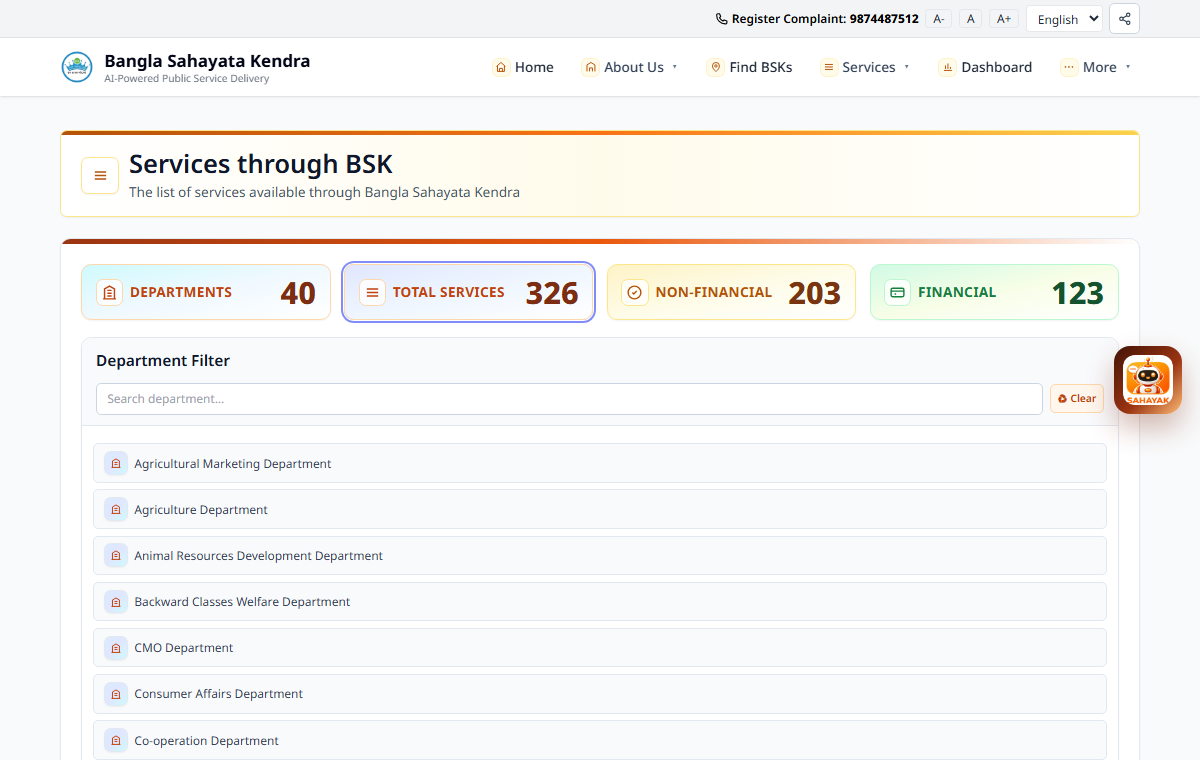
The catalogue shows which state services BSK assists with. A separate live centre check is required because Aadhaar capability applies only to selected BSKs.
- 1Official BSK catalogue
The Bangla Sahayata Kendra identity and government domain identify the source.
- 2Filter by service
Use department/service filters rather than assuming every BSK offers every transaction.
- 3Departmental context
Aadhaar-and-mobile linking in a ration-card service changes the ration record, not UIDAI’s mobile field.
West Bengal data snapshot
The figures below come from UIDAI’s state/UT saturation report. They provide context for coverage; they do not identify a live centre or prove that every resident record is current.
UIDAI refreshes this report PDF in place. The figures on this page reflect the report dated 30 June 2026; the current UIDAI link may show a newer or older edition. Open the archived 30 June 2026 edition.
| Measure | Value |
|---|---|
| Projected population (2026) | 10,05,22,000 |
| Estimated live Aadhaar | 10,03,99,328 |
| Saturation | 99.88% |
| Data date | 30 Jun 2026 |